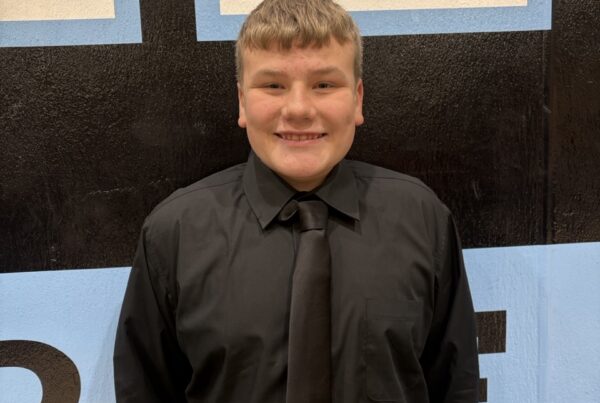
Ella, a senior at Canon Mac High School, begins her story with genuine honesty: “My name is Ella, and I don’t consider myself to be traditionally religious.” That willingness to start exactly where she is, without polishing the edges, is part of what we hope every student experiences at Youth for Christ: a place where they are taken seriously, listened to well, and invited into the true story God is writing in real lives, not the version that fits neatly inside a checkbox.
“My Grandma used to take me to Sunday school from when I was around four to about twelve,” she writes, remembering what she loved: “I loved everything to do with the games and lessons, especially whenever they would put on classics like Veggie Tales.” Yet what stays with her is what she carried home afterward, the way she left with “a smile on my face and an eagerness in my heart to tell my grandma the lesson I learned that day.” In those early years, faith did not feel like pressure or performance; it felt like possibility, and Ella names it plainly: “It felt like with Jesus by my side, I could do and be anything!”
Even then, Ella noticed what she wanted her life to center around, and she still holds that desire as a core conviction. “The thing I wanted more than anything at that age, was to share kindness,” she writes, and then she draws a straight line from childhood to who she is now: “I’m a firm believer today that kindness and compassion is one of the strongest tools in the world for building a better tomorrow.” This simple statement frames the rest of her story not as a label she adopted, but as a search for what is true, what is good, and what can hold up under real suffering.
That suffering arrived in a way that changed everything, “around sixth grade during the pandemic is when I lost my faith.” This is the kind of question that echoes in a lot of teenagers’ hearts when the world gets dark too quickly: “I remember thinking to myself, why would all of these awful, hopeless things happen to so many innocent people? Didn’t God love us?”
Additionally, she shares “I was battling some pretty major mental health issues during this period of my life, and that only furthered my estrangement.” She carried a quiet guilt alongside the distance, “I always felt slightly guilty deep down, with my grandma constantly reminding me on how I never go to church anymore.” Then she puts words to a struggle many students feel but do not know how to explain: “If God was so real, why didn’t I feel Him at worship like people said I would? For the longest time, I just couldn’t connect to it. It took me until my senior year to start [paying attention to] my faith again [and asking the questions on my heart out loud].”
Before senior year, Ella acknowledges “a lot of craziness had happened between the six years I was completely distanced from the concept of faith.” Amazingly, she can recall the small, subtle ways God continued to pursue her, “a lot of times I did have close run-ins with people and events that made me reconsider the idea of God.”
“Getting invited to Campus Life was truly the turning point,” Ella writes. It was the moment her questions moved from circling in her own head to being spoken in a community that could hold them.
“I’ve met so many amazing people and leaders who are willing to listen to my questions judgment free,” she says, “I’ve never once felt excluded or ignored, even when I’ve talked about my own light critical thoughts about certain Bible teachings and interpretations.” That kind of posture, warm, steady, anchored and unafraid of honesty, is often where faith can become possible again, not because every question is resolved all at once, but because a student discovers they do not have to perform certainty in order to belong.
Ella also refuses to pretend she fits a stereotype, and her honesty here makes her faith feel more credible, not less. “I’m in no way a typical Christian in the slightest, from my lifestyle to my interests,” she writes, yet she has the tools to find faith day-to-day. “There is one thing that truly connects me to God; finding Him in people. I’ve learned that I worship by finding the good and beauty in imperfection and humanity,” and she closes her story with a sentence that feels like both gratitude and testimony: “Finding faith through the people who have stuck with me through rain or shine is truly how I’ve rekindled my passion for building that truly better tomorrow.”